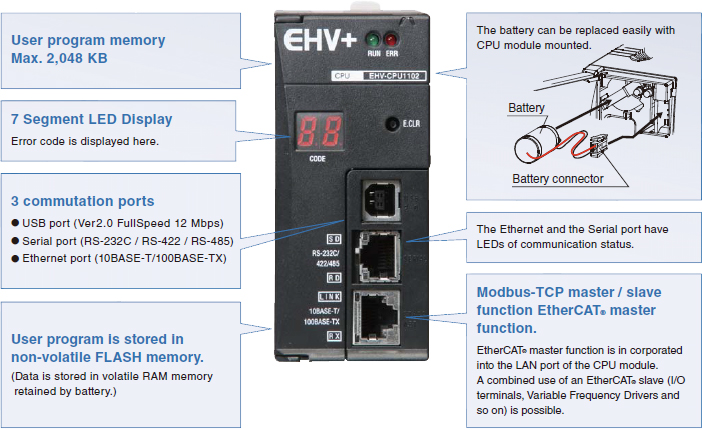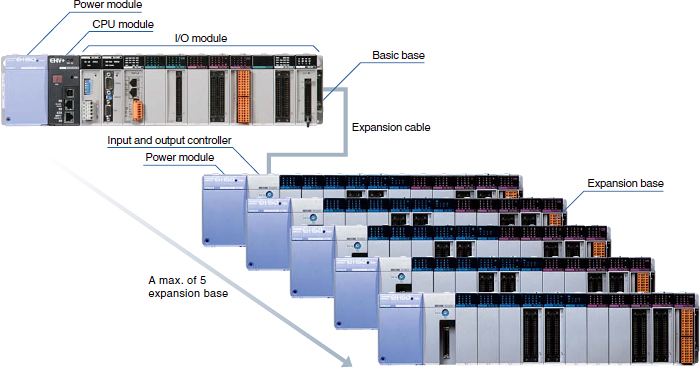
EHV+ Series is small size but powerful PLC covering wide range of applications since it is possible to expand up to 5 expansion bases, which offers max. 4,224 I/O points in 66 I/O modules.
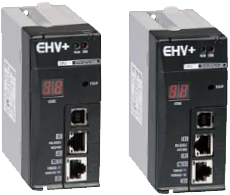
| Items | EHV-CPU1025 | EHV-CPU1102 | ||||||||||||||||
|---|---|---|---|---|---|---|---|---|---|---|---|---|---|---|---|---|---|---|
| User program memory | 512KB | 2,048KB | ||||||||||||||||
| Source file memory | 4,864KB | |||||||||||||||||
| Data memory (non retain) | 384KB | |||||||||||||||||
| Data memory (retain) | 64KB | |||||||||||||||||
| Data memory (persistent) | 64KB | |||||||||||||||||
| Data memory (Fieldbus) | 16KB (2KB×8 = 1KW×8) | |||||||||||||||||
| No. of expansion base | 5 | |||||||||||||||||
| No. of I/O (using 64 pts module) | 4,224 | |||||||||||||||||
| No. of logical port for Gateway* | 6 | |||||||||||||||||
| Programming languages | IEC61131-3 compliant 5 languages
|
|||||||||||||||||
| I/O updating cycle | Refresh processing | |||||||||||||||||
| Communication | Protocol | CODESYS V3 protocol | ||||||||||||||||
| USB | USB 2.0 Full speed (Gateway*) | |||||||||||||||||
| Ethernet | 10BASE-T / 100BASE-TX (Gateway*, Modbus-TCP client / server, EtherCAT® master, Global network variables) | |||||||||||||||||
| Serial | RS-232C / 422 / 485 (Modbus-RTU master, General purpose) | |||||||||||||||||
| Switch, indications | Indications | RUN LED, ERR LED, 7-segment LED (2 digits) | ||||||||||||||||
| RUN switch | STOP / RUN (Remote RUN / STOP enabled when the switch position is in RUN.) | |||||||||||||||||
| E.CLR button | Reset error information | |||||||||||||||||
| Calendar clock | Support (Built-in RTC) | |||||||||||||||||
| Battery | LIBAT-H (for RTC and RETAIN data) | |||||||||||||||||
| Maintenance function | Diagnosis (micro processor error, watch dog timer error, memory error, battery error, etc.) | |||||||||||||||||
| Items | Specifications |
|---|---|
| Communication protocol | EtherCAT® protocol |
| Supported services | CoE (process data communications and SDO communications) |
| Synchronization | None (DC is not supported) |
| Physical layer | 100BASE-TX |
| Modulation | Baseband |
| Baud rate | 100M bits/s (100BASE-TX) |
| Duplex mode | Full / Auto |
| Topology | Daisy chain, branch wiring |
| Transmission media | Category 5 shielded twisted-pair cable or higher |
| Transmission distance | Distance between nodes: 100m or less (IEEE802.3) |
| Maximum number of slaves | 255 |
| Maximum process data size | Input 5,736 bytes, Output 5,736 bytes |
| Maximum data sizes per slave | Input 1,434 bytes, Output 1,434 bytes |
| Maximum message size | 2,048 bytes |
| Minimum communications cycle | 10ms |
| Sync jitter between slaves | 1μs |
| Process data communications | PDO mapping using CoE Fail-soft operation for slave communications errors Stop operation for slave communications errors |
| SDO communications | CoE - Emergency message server (receptions from slaves) - SDO requests and responses |
| Configuration | Setting node address using HX-CODESYS network scan Display of network configuration information |
| RAS functions | Slave configuration check when starting network Reading of error information Trouble shooting information |
| Slave information | - Automatic reboot of the slaves - Scanning slaves supported |
| Mailbox support | CoE (CAN open / CAN application layer over EtherCAT®) SoE (Servodrive over EtherCAT®) FoE (File over EtherCAT®) VoE (Vendor over EtherCAT®) |
Note :

 Search
 Global